What a website audit report should actually tell you (and what 2,133 of them found)
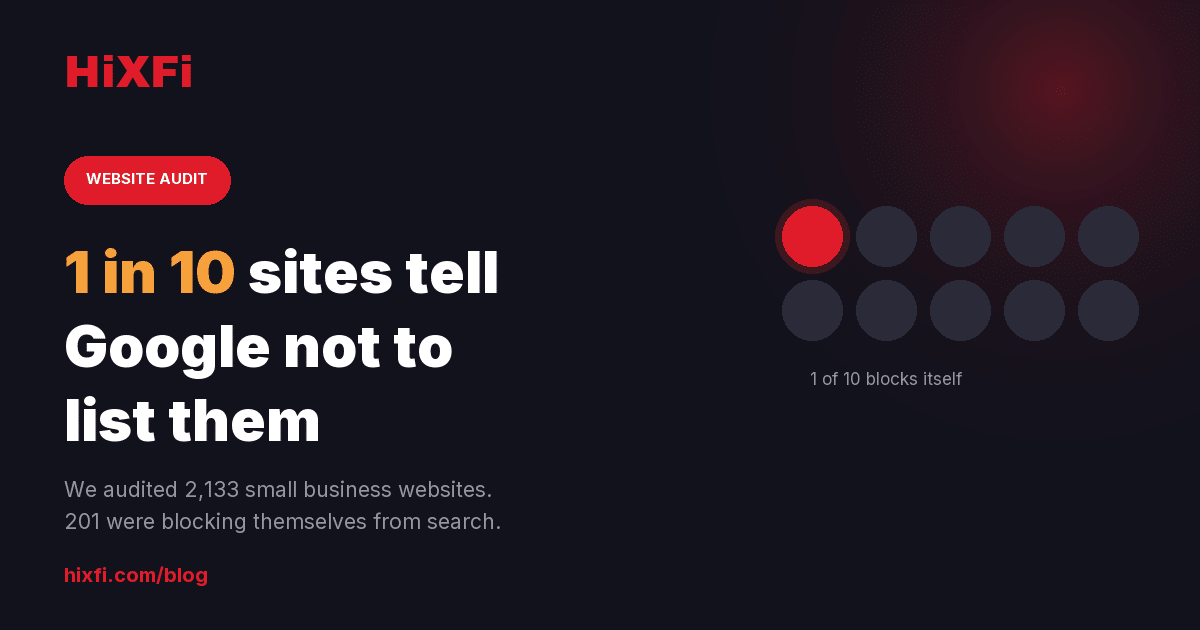
La mayoría de los informes de auditoría web dan una nota sobre 100 y una lista de cuarenta advertencias ordenadas por color. Eso no es un informe, es un inventario. Un informe útil responde cinco preguntas, y la primera es si su sitio siquiera tiene permiso para salir en Google. Auditamos 2,133 sitios de negocios pequeños y 201 le están diciendo a Google que no los liste. Casi uno de cada diez, y prácticamente ninguno lo sabe.
Qué medimos
Estas son auditorías que corrimos nosotros sobre 2,133 sitios distintos de negocios pequeños de Estados Unidos, entre mayo y septiembre de 2026. La auditoría descarga la página principal y la lee como lo haría un rastreador: las etiquetas que explican de qué va la página, las señales que permiten o bloquean su indexación, la velocidad, la forma de contacto y las herramientas de medición instaladas.
La nota mediana fue 61 sobre 100, y solo el 4.4% pasó de 80. Pero la nota es lo menos interesante del informe, y ahora verá por qué.
1. ¿Su sitio tiene permiso para aparecer en Google?
Esta es la primera pregunta y la que casi ningún informe pone arriba. Si la respuesta es no, todo lo demás da igual: puede tener el sitio más rápido y mejor escrito del sector y no existir para nadie que lo busque.
Hay dos formas de bloquearse sin querer. Una etiqueta noindex en la portada, que suele quedarse puesta desde que el sitio estaba en construcción. O un archivo robots.txt que le dice al buscador que no pase.
La cifra principal
Sitios que le piden activamente a Google que no los liste
201 de 2,133 sitios, entre etiqueta noindex en la portada y robots.txt bloqueando el rastreo. Auditorías de HiXFi, mayo a septiembre de 2026.
Son 201 negocios pagando hosting, pagando diseño, quizá pagando publicidad, con un cartel invisible que dice “no me listes”. Un informe de auditoría que entierra esto en la página seis entre advertencias de prioridad media no está haciendo su trabajo.
2. ¿Puede una máquina saber de qué va la página?
Suponiendo que sí esté permitido, lo siguiente es si el buscador entiende qué ofrece. Y aquí la carencia más común no es exótica: es el titular principal de la página.
Lo que falta
Ausencias en la portada de negocios pequeños
n = 2,133 sitios. El titular principal es la etiqueta H1, la que resume de qué trata la página.
580 sitios no tienen ningún titular principal. De hecho, cuando miramos qué era lo más grave de cada sitio auditado, la falta de ese titular encabezó la lista: fue el problema número uno en el 15.9% de los casos, más del triple que el siguiente.
3. ¿Puede un cliente contactarlo?
Un informe que solo habla de posicionamiento se olvida de para qué existe el sitio. El 36.9% no muestra un número de teléfono en la portada. Casi tres de cada diez no muestran ni teléfono ni correo.
Si vende servicios a domicilio, si arregla coches, si atiende urgencias, ese dato importa más que cualquier etiqueta.
4. ¿Es soportable en un teléfono?
Aquí conviene ser honesto con lo que una herramienta puede y no puede decirle. Medimos los tiempos de carga en condiciones de laboratorio, con conexión móvil simulada, y las cifras salen malas en casi todos los casos. Pero un número de laboratorio no es lo que vive su cliente, y cualquier informe que se lo presente como si lo fuera le está vendiendo alarma.
Lo que sí es un hecho comprobable: el 58.5% no comprime sus páginas antes de enviarlas. Eso es una casilla en el servidor, no un rediseño, y hace que todo viaje más pesado de lo necesario, sobre todo con datos móviles.
5. ¿Podrá saber si algo de esto funcionó?
La última pregunta es la que convierte un informe en un plan. Si arregla todo lo anterior, ¿con qué va a comprobar que sirvió?
Medición
Sitios sin ninguna herramienta de analítica instalada
n = 2,133. Cuenta cualquier instalación de Google Analytics o Tag Manager.
Más de la mitad no tiene con qué. Para esos negocios, cualquier mejora es un acto de fe: no van a poder distinguir un cambio que funcionó de una buena semana.
Por qué la nota sobre 100 es la parte menos útil
Volvamos al 61 de mediana. Esa cifra no le dice qué hacer el lunes. Dos sitios con 61 pueden tener problemas opuestos: uno rapidísimo pero bloqueado en Google, otro perfectamente indexado pero que tarda nueve segundos en un móvil.
Un informe honesto ordena por consecuencia, no por severidad técnica. Primero lo que le impide existir. Después lo que le impide ser entendido. Después lo que le impide ser contactado. Y al final lo cosmético.
Si su informe empieza con una rueda de colores y termina con cuarenta y siete recomendaciones sin prioridad, tiene un inventario. Pídale a quien se lo hizo una sola cosa: cuál es la primera que debería arreglar y por qué esa.
Lo que este estudio no prueba
Dos límites. La auditoría mira la página principal, no el sitio entero, así que un problema que solo exista en páginas internas no aparece aquí. Y los 2,133 sitios no son una muestra aleatoria de la web: son sitios que auditamos nosotros, así que no representan a todos los negocios.
Compruébelo usted mismo
La pregunta número uno de esta lista se responde en menos de un minuto, y es gratis. Nuestra auditoría web lee su portada y le dice en orden qué le impide aparecer, qué le impide ser entendido y qué le impide recibir una llamada. Sin cuenta, sin tarjeta, y con la primera acción concreta arriba del todo, no en la página seis.
Most website audit reports hand you a score out of 100 and forty warnings sorted by colour. That is not a report, it is an inventory. A useful one answers five questions, and the first is whether your site is even allowed to appear in Google. We audited 2,133 small business websites and 201 of them are telling Google not to list them. Nearly one in ten, and almost none of them know.
What we measured
These are audits HiXFi ran on 2,133 separate small business websites in the United States between May and September 2026. The audit fetches the homepage and reads it the way a crawler would: the tags that explain what the page is, the signals that allow or block indexing, the speed, the way to get in touch, and whatever measurement tools are installed.
The median score was 61 out of 100, and only 4.4% cleared 80. But the score is the least interesting part of the report, and you are about to see why.
1. Is your site allowed to appear in Google at all?
This is the first question and the one almost no report puts at the top. If the answer is no, nothing else matters: you can have the fastest, best written site in your trade and still not exist for anyone searching for it.
There are two ways to block yourself by accident. A noindex tag on the homepage, usually left over from when the site was being built. Or a robots.txt file telling the crawler to stay out.
The headline number
Sites actively asking Google not to list them
201 of 2,133 sites, counting a noindex tag on the homepage and robots.txt blocking the crawl. HiXFi audits, May to September 2026.
That is 201 businesses paying for hosting, paying for design, possibly paying for ads, with an invisible sign reading “do not list me”. An audit report that buries this on page six among medium-priority warnings is not doing its job.
2. Can a machine tell what the page is about?
Assuming you are allowed in, the next question is whether the search engine understands what you offer. And the most common gap here is not exotic: it is the page’s main heading.
What is missing
Gaps on small business homepages
n = 2,133 sites. The main heading is the H1 tag, the one that sums up what the page is for.
580 sites have no main heading at all. In fact, when we looked at the single worst problem on each site audited, the missing heading topped the list: it was the number one issue on 15.9% of them, more than three times the next one.
3. Can a customer reach you?
A report that only talks about rankings forgets what the site is for. 36.9% show no phone number on the homepage. Nearly three in ten show neither a phone nor an email.
If you sell callouts, if you fix cars, if you handle emergencies, that matters more than any tag.
4. Is it bearable on a phone?
Here it is worth being straight about what a tool can and cannot tell you. We measure load times in lab conditions, on a simulated mobile connection, and the numbers come out bad almost everywhere. But a lab number is not what your customer lives through, and any report that presents it as though it were is selling you alarm.
What is checkable fact: 58.5% do not compress their pages before shipping them. That is a switch on the server, not a redesign, and it makes everything travel heavier than it needs to, especially on mobile data.
5. Will you be able to tell if any of it worked?
The last question is the one that turns a report into a plan. If you fix everything above, what are you going to check it against?
Measurement
Sites with no analytics tool installed at all
n = 2,133. Counts any Google Analytics or Tag Manager install.
More than half have nothing to check against. For those businesses every improvement is an act of faith: they will not be able to tell a change that worked from a good week.
Why the score out of 100 is the least useful part
Back to that median of 61. The number does not tell you what to do on Monday. Two sites scoring 61 can have opposite problems: one blazing fast but blocked from Google, the other perfectly indexed but nine seconds slow on a phone.
An honest report sorts by consequence, not by technical severity. First what stops you existing. Then what stops you being understood. Then what stops you being contacted. Cosmetics last.
If your report opens with a coloured dial and closes with forty-seven unranked recommendations, you have an inventory. Ask whoever produced it one thing: which one should I fix first, and why that one.
What this study does not prove
Two limits. The audit looks at the homepage, not the whole site, so a problem that only exists on inner pages will not show up here. And the 2,133 sites are not a random sample of the web: they are sites we audited ourselves, so they do not represent every business.
Check it yourself
Question one on this list takes under a minute to answer, and it is free. Our website audit reads your homepage and tells you, in order, what is stopping you appearing, what is stopping you being understood, and what is stopping you getting a call. No account, no card, and the first concrete action at the top rather than on page six.