Your business does not show up when someone asks ChatGPT. This is what the AI actually reads.
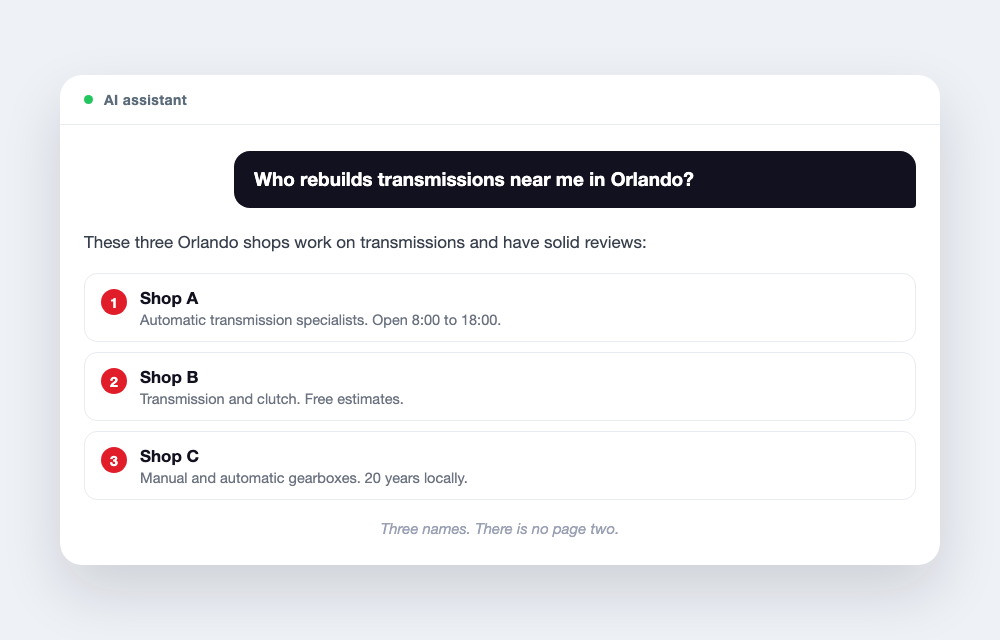
Last year, 6 in 100 people used an AI assistant to find a local business. This year it is 45. They ask ChatGPT “who rebuilds transmissions near me?” and they go with the three names it gives them. If yours is missing, it is not because AI dislikes you. It is because it found nothing to read.
Rather than take anyone’s predictions for it, we requested seven Orlando business websites exactly the way an AI crawler requests them, and looked at what came back.
The shift
People using an AI assistant to find a local business
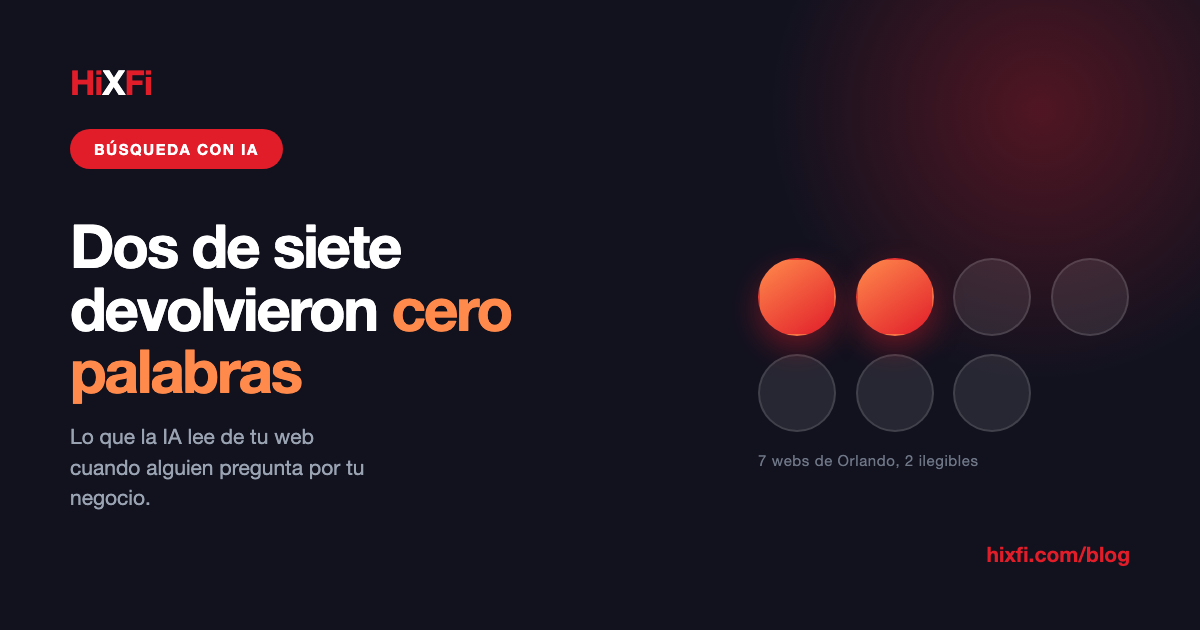
Two out of seven returned zero words
Not few words. Zero.
These are real businesses with good-looking sites that render perfectly on your phone. But they are built so the text only appears after the browser runs JavaScript. Most AI crawlers do not wait for that: they request the document, read what arrives, and move on.
What they got from those two sites was an empty shell. No business name, no services, no phone number, no hours. To ChatGPT, that shop does not exist.
The same page
What your customer sees, and what the AI receives
Empty document.
The rest of the picture:
- Zero of seven blocked AI crawlers. Nobody is defending against this.
- Two of seven had no structured data at all, the format search engines read to know what you are, where you are, and when you open.
- Six of seven had no file telling an assistant what the site is about.
Put differently: the door is not locked. There is simply nothing behind it.
What we measured
Seven Orlando business sites, requested the way an AI crawler requests them
What an AI actually reads from your site
When someone asks an assistant about a business like yours, this happens:
- It requests your page and receives the raw document. It does not see your design. It does not see your animations. It receives text and tags.
- It tries to separate signal from noise. Menus, cookie banners, footers, ad scripts. It has to guess which part is your business.
- It looks for structured data. An invisible spec sheet in your code that states plainly: this is an auto shop, at this address, open these hours, offering these services.
- It favours what is recent. A page updated this month outweighs one from 2023.
Step 3 is the one almost nobody has. It is also the cheapest to fix.
Four checks you can run today
No paid tools, no coding.
1. Turn JavaScript off and look at your site
In Chrome, open your site, press F12, find the developer tools settings and disable JavaScript. Reload.
If the page goes blank, that is exactly what AI sees. It is the harshest test and the most revealing.
2. Look for your structured data
Go to validator.schema.org and paste your web address. If nothing comes back, no search engine knows for certain what you do. It is guessing.
3. Ask it directly
Open ChatGPT and type: “What do you know about [your business name] in Orlando?” The answer tells you exactly what it has and where it came from. Sometimes it comes from an old directory with your previous phone number.
4. Check your Google profile
Assistants lean on it heavily. If your hours are stale or your services are incomplete there, that error propagates into every answer about you.
What to fix, in this order
First, make sure your text exists without JavaScript. If your site failed check 1, nothing else matters. It is the most expensive of the four fixes, but without it there is nothing to optimise.
Second, add structured data. Name, address, phone, hours, services, service area. A block of code invisible to your customers and decisive for machines.
Third, write the answers, not just the services. A page that says “Services: brakes” competes worse than one answering “How much does a brake pad replacement cost in Orlando?” Assistants cite what answers questions, because that is what they were asked for.
Fourth, keep your Google profile and reviews current. Freshness counts: a review from three weeks ago outweighs fifteen from two years ago.
What this actually means
For twenty years the goal was to appear in a list of links. People clicked, visited, and decided.
Now a growing share of your customers never sees that list. They see an answer with three names, and there is no page two. The top 20% of businesses already take 68% of local visibility, up from 52% three years ago. The gap is closing, and it closes in favour of whoever prepared first.
The good news is that, judging by what we found in Orlando, almost nobody has prepared yet. Two out of seven businesses are not even readable. That is an advantage sitting on the table, and it is temporary.
How we tested: in September 2026 we requested the homepage of seven Orlando-area business websites using an identified agent, without executing JavaScript, the way an AI crawler does. We measured the readable text received, the presence of structured data, and the declared access rules. We name none of them: the point was to measure the pattern, not to single anyone out.