Tu negocio no aparece cuando alguien le pregunta a ChatGPT. Esto es lo que lee la IA
El año pasado, 6 de cada 100 personas usaban un asistente de IA para encontrar un negocio local. Este año son 45. Le preguntan a ChatGPT “¿quién arregla transmisiones cerca de mí?” y se quedan con los tres nombres que salen. Si el tuyo no está, no es porque la IA te odie. Es porque no encontró nada que leer.
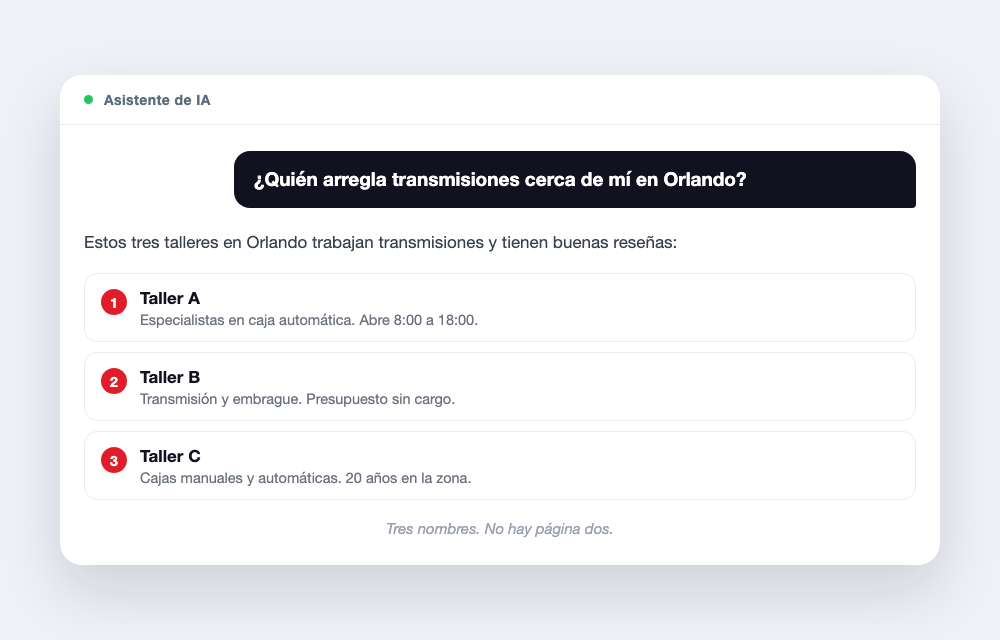
Para escribir esto no nos fiamos de las predicciones de nadie. Pedimos siete webs de negocios de Orlando exactamente como las pide un bot de IA, y miramos qué recibían.
El cambio
Gente que usa un asistente de IA para encontrar un negocio local
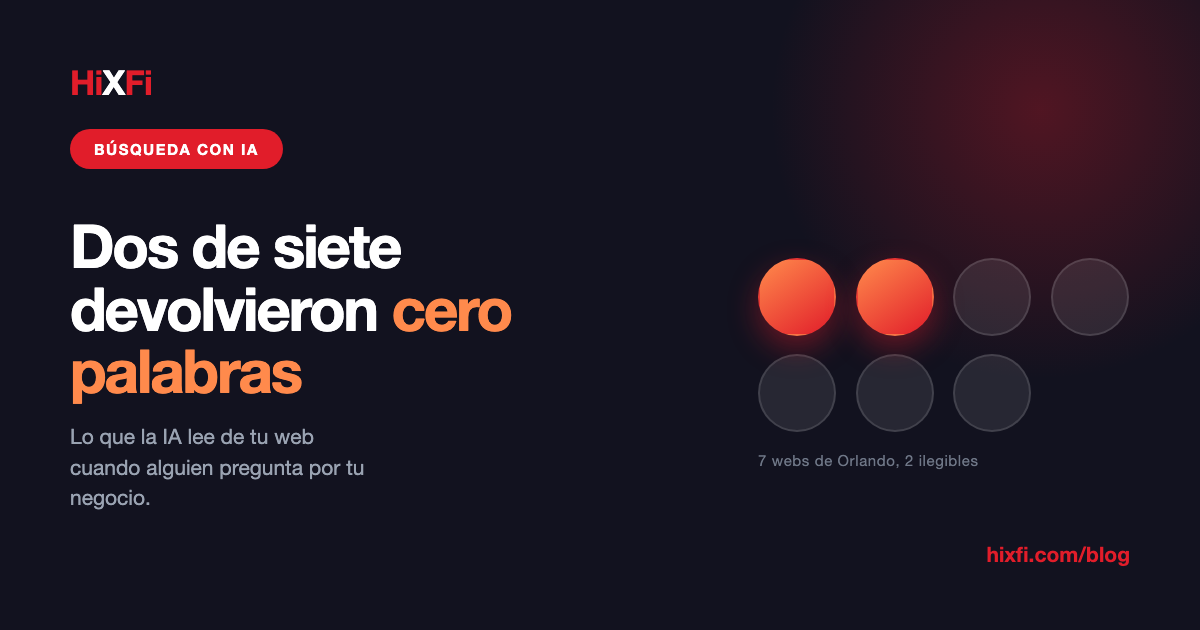
Dos de siete devolvieron cero palabras
No pocas palabras. Cero.
Son negocios reales, con webs bonitas, que se ven perfectas en tu teléfono. Pero están hechas de forma que el texto aparece solo después de que el navegador ejecute JavaScript. Y la mayoría de los rastreadores de IA no esperan a eso: piden el documento, leen lo que viene, y siguen.
Lo que recibieron de esas dos webs fue un esqueleto vacío. Ni el nombre del negocio, ni los servicios, ni el teléfono, ni el horario. Para ChatGPT, ese taller no existe.
La misma página
Lo que ve tu cliente y lo que recibe la IA
Documento vacío.
El resto del cuadro:
- Cero de siete bloqueaban a los bots de IA. Nadie se está defendiendo de esto.
- Dos de siete no tenían ni un dato estructurado, que es el formato que los buscadores leen para saber qué eres, dónde estás y a qué hora abres.
- Seis de siete no tenían ningún archivo que le explique a un asistente de qué va el sitio.
Dicho de otro modo: el problema no es que la puerta esté cerrada. Es que detrás no hay nada.
Lo que medimos
Siete webs de negocios de Orlando, pedidas como las pide un bot de IA
Qué lee realmente una IA de tu web
Cuando alguien le pregunta a un asistente por un negocio como el tuyo, pasa esto:
- Pide tu página y recibe el documento en bruto. No ve tu diseño. No ve tus animaciones. Recibe texto y etiquetas.
- Intenta separar lo importante del ruido. Menús, avisos de cookies, pies de página, scripts de publicidad. Tiene que adivinar qué parte es tu negocio.
- Busca datos estructurados. Es una ficha técnica invisible, en el código, que dice sin ambigüedad: esto es un taller mecánico, está en esta dirección, abre a estas horas, hace estos servicios.
- Le da más peso a lo reciente. Una página actualizada este mes pesa más que una de 2023.
El paso 3 es el que casi nadie tiene. Y es el más barato de arreglar.
Cuatro comprobaciones que puedes hacer tú hoy
No necesitas herramientas de pago ni saber programar.
1. Apaga JavaScript y mira tu web
En Chrome, abre tu web, pulsa F12, busca los ajustes de las herramientas de desarrollo y desactiva JavaScript. Recarga.
Si la página se queda en blanco, eso es exactamente lo que ve la IA. Es la prueba más dura y la más reveladora.
2. Busca tus datos estructurados
Ve a validator.schema.org y pega la dirección de tu web. Si no sale nada, ningún buscador sabe con certeza a qué te dedicas: lo está deduciendo.
3. Pregúntale directamente
Abre ChatGPT y escribe: “¿Qué sabes de [nombre de tu negocio] en Orlando?”. La respuesta te dice, sin rodeos, qué información tiene y de dónde la sacó. A veces la saca de un directorio viejo con tu teléfono anterior.
4. Mira tu perfil de Google
Los asistentes se apoyan mucho en él. Si tu horario está desactualizado o tus servicios están incompletos ahí, ese error se propaga a todas las respuestas sobre ti.
Qué arreglar, en este orden
Primero, que tu texto exista sin JavaScript. Si tu web falló la comprobación 1, lo demás da igual. Es el arreglo más caro de los cuatro, pero sin él no hay nada que optimizar.
Segundo, añade datos estructurados. Nombre, dirección, teléfono, horario, servicios, zona que cubres. Es un bloque de código invisible para tus clientes y decisivo para las máquinas.
Tercero, escribe las respuestas, no solo los servicios. Una página que dice “Servicios: frenos” compite peor que una que responde “¿Cuánto cuesta cambiar las pastillas de freno en Orlando?”. Los asistentes citan lo que responde preguntas, porque es lo que les están pidiendo.
Cuarto, mantén tu perfil de Google y tus reseñas al día. La frescura importa: una reseña de hace tres semanas pesa más que quince de hace dos años.
Lo que esto significa de verdad
Durante veinte años el objetivo fue salir en una lista de enlaces. La gente hacía clic, entraba y decidía.
Ahora una parte creciente de tus clientes no ve esa lista. Ve una respuesta con tres nombres, y no hay página dos. El 20% de los negocios ya se lleva el 68% de la visibilidad local, cuando hace tres años era el 52%. El hueco se está cerrando, y se cierra a favor de quien se preparó antes.
La buena noticia es que, por lo que vimos en Orlando, casi nadie se ha preparado todavía. Dos de siete negocios ni siquiera son legibles. Eso es una ventaja disponible, y es temporal.
Cómo hicimos esta prueba: en septiembre de 2026 pedimos la portada de siete webs de negocios del área de Orlando usando un agente identificado, sin ejecutar JavaScript, tal como lo hace un rastreador de IA. Medimos el texto legible recibido, la presencia de datos estructurados y las reglas de acceso declaradas. No nombramos a ninguno: el objetivo era medir el patrón, no señalar a nadie.
Last year, 6 in 100 people used an AI assistant to find a local business. This year it is 45. They ask ChatGPT “who rebuilds transmissions near me?” and they go with the three names it gives them. If yours is missing, it is not because AI dislikes you. It is because it found nothing to read.
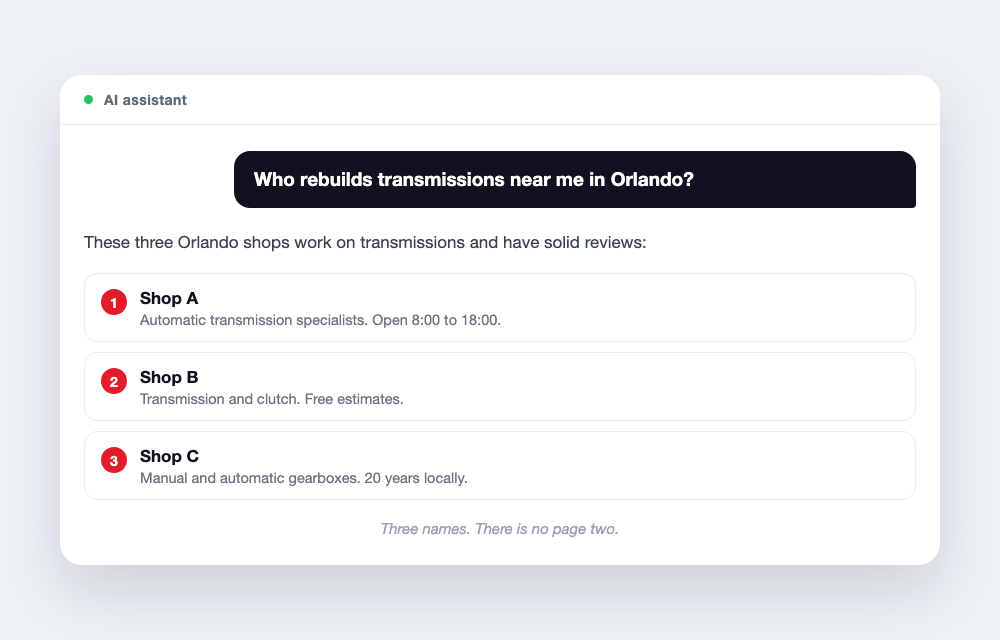
Rather than take anyone’s predictions for it, we requested seven Orlando business websites exactly the way an AI crawler requests them, and looked at what came back.
The shift
People using an AI assistant to find a local business
Two out of seven returned zero words
Not few words. Zero.
These are real businesses with good-looking sites that render perfectly on your phone. But they are built so the text only appears after the browser runs JavaScript. Most AI crawlers do not wait for that: they request the document, read what arrives, and move on.
What they got from those two sites was an empty shell. No business name, no services, no phone number, no hours. To ChatGPT, that shop does not exist.
The same page
What your customer sees, and what the AI receives
Empty document.
The rest of the picture:
- Zero of seven blocked AI crawlers. Nobody is defending against this.
- Two of seven had no structured data at all, the format search engines read to know what you are, where you are, and when you open.
- Six of seven had no file telling an assistant what the site is about.
Put differently: the door is not locked. There is simply nothing behind it.
What we measured
Seven Orlando business sites, requested the way an AI crawler requests them
What an AI actually reads from your site
When someone asks an assistant about a business like yours, this happens:
- It requests your page and receives the raw document. It does not see your design. It does not see your animations. It receives text and tags.
- It tries to separate signal from noise. Menus, cookie banners, footers, ad scripts. It has to guess which part is your business.
- It looks for structured data. An invisible spec sheet in your code that states plainly: this is an auto shop, at this address, open these hours, offering these services.
- It favours what is recent. A page updated this month outweighs one from 2023.
Step 3 is the one almost nobody has. It is also the cheapest to fix.
Four checks you can run today
No paid tools, no coding.
1. Turn JavaScript off and look at your site
In Chrome, open your site, press F12, find the developer tools settings and disable JavaScript. Reload.
If the page goes blank, that is exactly what AI sees. It is the harshest test and the most revealing.
2. Look for your structured data
Go to validator.schema.org and paste your web address. If nothing comes back, no search engine knows for certain what you do. It is guessing.
3. Ask it directly
Open ChatGPT and type: “What do you know about [your business name] in Orlando?” The answer tells you exactly what it has and where it came from. Sometimes it comes from an old directory with your previous phone number.
4. Check your Google profile
Assistants lean on it heavily. If your hours are stale or your services are incomplete there, that error propagates into every answer about you.
What to fix, in this order
First, make sure your text exists without JavaScript. If your site failed check 1, nothing else matters. It is the most expensive of the four fixes, but without it there is nothing to optimise.
Second, add structured data. Name, address, phone, hours, services, service area. A block of code invisible to your customers and decisive for machines.
Third, write the answers, not just the services. A page that says “Services: brakes” competes worse than one answering “How much does a brake pad replacement cost in Orlando?” Assistants cite what answers questions, because that is what they were asked for.
Fourth, keep your Google profile and reviews current. Freshness counts: a review from three weeks ago outweighs fifteen from two years ago.
What this actually means
For twenty years the goal was to appear in a list of links. People clicked, visited, and decided.
Now a growing share of your customers never sees that list. They see an answer with three names, and there is no page two. The top 20% of businesses already take 68% of local visibility, up from 52% three years ago. The gap is closing, and it closes in favour of whoever prepared first.
The good news is that, judging by what we found in Orlando, almost nobody has prepared yet. Two out of seven businesses are not even readable. That is an advantage sitting on the table, and it is temporary.
How we tested: in September 2026 we requested the homepage of seven Orlando-area business websites using an identified agent, without executing JavaScript, the way an AI crawler does. We measured the readable text received, the presence of structured data, and the declared access rules. We name none of them: the point was to measure the pattern, not to single anyone out.